Introduction
Here is a figure to start with: in 2026, sub-Saharan Africa has more than 600 million mobile subscribers, yet only 30% of the population has access to the Internet. At the same time, data traffic on the continent is growing by more than 20% per year. This gap between demand and available access is precisely where one of the greatest economic opportunities of the twenty-first century lies — and where your place in this digital revolution will be found.
Fiber optics is not just a cable. In Africa, it is the infrastructure on which tomorrow’s economies are being built: online education, e-commerce, connected healthcare, precision agriculture, and mobile financial services. Every kilometre of fiber laid opens new markets, creates new services, and generates new jobs.
This course gives you a panoramic view of this fast-growing sector: where Africa stands today, what investments are under way, and above all, what your place is in the massive rollout that lies ahead over the next ten years.
1. The African digital landscape in 2026
A continent connecting at accelerating speed
Africa is the world’s youngest continent — with a median age of around 19 — and it is also the fastest-growing digital market. This combination of demographic and technological factors creates a particularly favourable environment for investment in telecoms infrastructure.
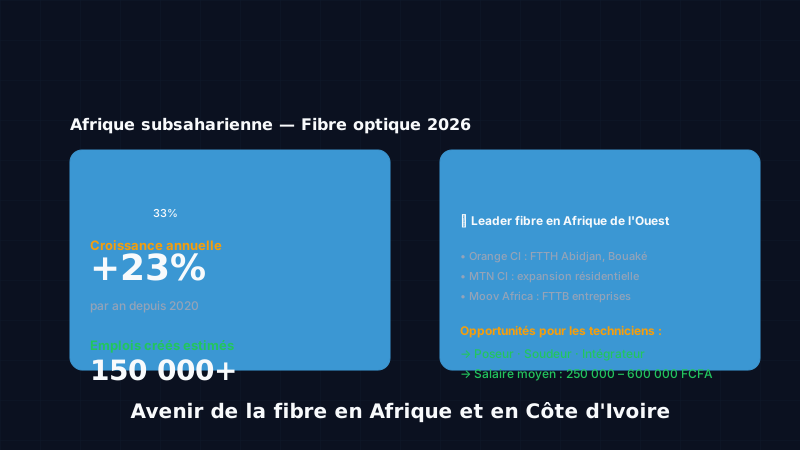
The Internet penetration rate in sub-Saharan Africa rose from around 10% in 2015 to nearly 30% in 2026. This is still far from the 80–90% seen in Europe or North America, but the growth curve is spectacular: approximately +23% per year in the number of Internet users on the continent, compared with 3 to 5% in mature markets.
This growth is driven by several converging forces:
- The continuing fall in the cost of smartphones (functional entry-level devices are available for less than 30,000 FCFA — West African CFA franc)
- The expansion of 4G networks, now available in most large African cities
- The emergence of local digital services (M-Pesa in Kenya, Wave in West Africa, Jumia for e-commerce)
- Government policies to digitalise public services
Submarine cables: the motorways of African Internet
The global Internet rests on a network of submarine cables that carry more than 95% of international data traffic. For a long time, Africa was poorly connected to these global motorways — which limited available speeds and kept the cost of bandwidth very high.
The years 2020–2026 marked a major turning point with the commissioning of several giant submarine cables:
2Africa — the longest cable ever deployed (45,000 km), backed by Meta (Facebook) and a consortium of operators. It encircles Africa and connects 33 countries. Its theoretical capacity is 180 Tbit/s. Landings took place in 2024–2025.
Equiano — a Google cable linking Portugal to South Africa with landings in West Africa (including in Côte d’Ivoire). Capacity of 144 Tbit/s, in service since 2022.
PEACE — a cable linking Asia, the Middle East, East Africa, and Europe. Capacity of 60 Tbit/s.
This submarine infrastructure drastically reduces the cost of international bandwidth for African operators, which progressively translates into faster, cheaper Internet packages for end users.
Why 4G and 5G need fiber optics to function
A frequently misunderstood point: 4G and 5G need fiber optics to work. Every mobile antenna (4G BTS, 5G NR) must be connected to the operator’s core network by a high-speed link — this is called backhauling.
For a 4G antenna serving hundreds of simultaneous users, the backhaul link must be capable of carrying several hundred Mbit/s, or even a few Gbit/s. Only fiber optics can deliver this capacity reliably and at an acceptable long-term cost.
The rise of 5G, which African operators are beginning to deploy in major cities, amplifies this need further: a 5G antenna may require a backhaul link of 10 Gbit/s or more. Without fiber, there is no 5G. This link between mobile telephony and fiber optics is one of the main drivers of current investment.
The growth of African data centres
The explosion of digital services (video streaming, cloud computing, financial services) is creating growing demand for data centres across the continent. Having servers close to users reduces latency and improves experience. Major African cities are seeing increasingly important data centres emerge: Nairobi, Lagos, Johannesburg, and of course Abidjan.
These data centres must be connected to one another and to submarine cables by very high-capacity terrestrial fibers. Every data centre is a node that generates substantial fiber optic cabling in its surroundings.
2. Côte d’Ivoire: digital hub of West Africa
A dynamic economy undergoing rapid digital transformation
Côte d’Ivoire is one of the most dynamic economies in sub-Saharan Africa. Its GDP is approximately 85 billion USD in 2026, and the country has maintained a remarkable growth rate of around 7 to 8% per year since 2011, despite global headwinds.
This economic growth is inseparable from an accelerating digital transformation. The government has made the digital economy a central strategic axis, with the Côte d’Ivoire Numérique 2025 Plan targeting:
- Raising the Internet penetration rate to 60% of the population
- Deploying fiber optics across all 31 administrative regions
- Creating 100,000 jobs in the digital sector
- Making Abidjan a regional hub for start-ups and e-commerce
The Internet penetration rate in Côte d’Ivoire reached approximately 47% of the population in early 2026 according to ARTCI (Autorité de Régulation des Télécommunications/TIC de Côte d’Ivoire — the national telecoms regulator), one of the highest rates in West Africa.
Abidjan, crossroads of submarine cables
Abidjan’s geographic position on the Gulf of Guinea makes it a strategic landing point for the submarine cables serving West Africa. Côte d’Ivoire is currently connected to the following cables:
- SAT-3/WASC — one of the first cables to serve West Africa, commissioned in 2002, now capacity-constrained
- ACE (Africa Coast to Europe) — 17,000 km, linking Europe to South Africa via 22 landing points including Abidjan. Commissioned in 2012.
- WACS (West Africa Cable System) — 14,530 km, linking South Africa to the United Kingdom with landings in Côte d’Ivoire. Commissioned in 2012.
- Equiano (Google) — landing in Côte d’Ivoire, in service since 2023. Massive addition of international capacity.
The convergence of these submarine cables in Abidjan makes the Ivorian economic capital a major interconnection point for the entire sub-region. Operators from neighbouring Burkina Faso, Mali, Niger, and other landlocked countries route part of their international traffic through Côte d’Ivoire.
3. Operator investments in Côte d’Ivoire
Orange Côte d’Ivoire: FTTH rollout under way
Orange CI is the incumbent operator and market leader in Ivorian telecommunications. Since 2022, Orange CI has accelerated its FTTH deployment programme in residential and business areas of Abidjan.
Priority neighbourhoods have been those with high purchasing power and high residential density: Cocody (Riviera, Angré, Deux Plateaux), Marcory (Zone 4, Marcory Résidentiel), Plateau (business district), and progressively the popular communes of Yopougon, Abobo, and Adjamé.
Orange has also announced FTTH deployments in Bouaké (the country’s second city) and San Pedro (the main cocoa export port). This expansion beyond Abidjan is particularly significant because it opens new work areas for technicians trained outside the capital.
MTN CI: upgrading residential offerings
MTN CI, the second Ivorian operator, has announced significant investments in residential FTTH fiber in upmarket residential neighbourhoods of Abidjan. MTN is positioning itself in a slightly premium segment, with high-speed packages (100 Mbit/s to 1 Gbit/s) targeting expatriates and higher-income households.
Moov Africa: FTTB for businesses and buildings
Moov Africa (part of the Maroc Telecom group) is taking a complementary approach with a focus on FTTB (Fiber To The Building) — fiber to the building, with internal distribution via Ethernet or Wi-Fi. This approach targets office buildings, university residences, hotels, and large residential complexes.
Public investment in the national backbone
The Ivorian state, through CI Télécom (formerly Côte d’Ivoire Télécom), has developed a fiber optic backbone network crossing the country’s main cities. This network serves as wholesale infrastructure to which private operators can connect in order to deploy their services in the regions.
Projects financed by international partners (World Bank, African Union, AfDB) are under way to extend this backbone into rural areas, notably under the West Africa Regional Communications Infrastructure Programme (WARCIP).
4. Employment opportunities for fiber technicians
Enormous demand through 2030
Estimates from industry players in Côte d’Ivoire converge on an impressive figure: between 5,000 and 10,000 qualified technicians will be needed by 2030 to carry out the FTTH deployment programmes announced by operators. This shortage of qualified labour is one of the main obstacles to accelerating rollouts.
Why this shortage? Because fiber optics is a relatively recent technology in West Africa. Unlike copper, which built up its workforce over 60 years, fiber demands a mass of trained professionals within just a few years. Training centres like KMC play a strategic role in responding to this demand.
Salaries and working conditions
The job of fiber optic technician is well paid compared with many other sectors accessible without a long university degree. In Côte d’Ivoire, here is an estimate of earnings by experience and specialisation:
| Level | Profile | Estimated monthly salary (FCFA) |
|---|---|---|
| Entry | Trainee technician (0–1 year) | 150,000 — 250,000 FCFA |
| Junior | Splicing technician (1–3 years) | 250,000 — 400,000 FCFA |
| Experienced | Works technician / team leader (3–7 years) | 400,000 — 700,000 FCFA |
| Senior | Site manager / coordinator (7–12 years) | 600,000 — 1,000,000 FCFA |
| Expert | Technical director / network engineer (10+ years) | 1,000,000 — 2,000,000 FCFA+ |
These salaries should be compared with the Ivorian minimum wage (SMIG: 60,000 FCFA/month) and the average earnings in other unskilled sectors (100,000 — 150,000 FCFA/month). An experienced fiber technician earns two to four times the median Ivorian salary — a reality that explains the appeal of this profession.
Career progression: a real professional ladder
What makes this profession particularly attractive is the clear and rapid career progression for those who invest in it:
Level 1 — Field technician (0 to 3 years) Fiber splicing, optical welding, ONT installation, subscriber commissioning. Team-based work under the supervision of a team leader.
Level 2 — Team leader (3 to 5 years) Supervision of a team of 3 to 6 technicians, reading network plans, site reporting, coordination with subcontractors. First management experience.
Level 3 — Project manager / Works coordinator (5 to 10 years) Running a deployment programme (multiple teams, multiple simultaneous sites), site budget management, relationship with operator clients.
Level 4 — Technical director / Network engineer (10 years and more) Network architecture design, deployment dimensioning, technical team management, relationships with equipment manufacturers.
Entrepreneurship opportunities
Many experienced fiber technicians take a further step: setting up their own business. Operators do not carry out all the work themselves — they subcontract the vast majority of civil engineering and splicing work to specialist companies.
A small fiber optic works company can start with a relatively modest investment (a utility vehicle, splicing equipment, consumables stock) and obtain contracts from major operators or their tier-one subcontractors. Entrepreneurs trained at KMC have successfully followed this path.
5. Challenges to overcome
The cost of deployment in rural areas
While FTTH deployments are progressing well in major cities, rural areas remain largely disconnected. The problem is economic: deploying fiber to a village of 2,000 people 50 km from a city costs almost as much as deploying in an urban neighbourhood of 50,000, but generates far less revenue.
Solutions being considered combine public subsidies, infrastructure-sharing models between operators, and alternative technologies for the “last kilometres” (fiber to the sub-prefecture capital, then long-range Wi-Fi or radio-frequency links to cover surrounding villages).
Cable vandalism
In some areas, fiber optic cables are subject to vandalism or theft — either because people expect to find copper inside (fiber contains none, though associated electrical service cables do), or simply through accidental damage during uncoordinated works.
Operators are responding by burying cables more deeply, using heavily armoured conduits that are difficult to cut, and developing network supervision systems that detect breaks within minutes.
Shortage of qualified technicians
As noted above, the shortage of qualified labour is one of the main obstacles to deployments. Operators face intense competition to recruit the right profiles, resulting in extended project timelines and higher deployment costs.
It is precisely in this context that training centres like KMC play a crucial role. Training qualified and certified technicians is a direct contribution to accelerating the country’s digital deployment.
Regulation and market competition
The telecoms sector is regulated by the ARTCI, which sets deployment conditions, universal service obligations, and the terms for infrastructure sharing between operators. Regulatory changes can accelerate or slow investment — an important parameter in the sector’s economic landscape.
6. Starlink vs Fiber: a threat or a complement?
Starlink’s arrival in Côte d’Ivoire
Starlink, Elon Musk’s (SpaceX) satellite telecommunications service, began offering its services in Côte d’Ivoire from 2023. The service uses a constellation of satellites in Low Earth Orbit (LEO), at approximately 550 km altitude, which considerably reduces latency compared with traditional geostationary satellites (which orbit at 36,000 km).
Starlink characteristics:
- Downstream speed: typically 50 to 200 Mbit/s
- Latency: 20 to 60 ms (versus 600 ms for GEO satellites)
- Cost: installation kit at approximately 300,000 — 400,000 FCFA + monthly subscription of 30,000 — 50,000 FCFA
- Installation: motorised parabolic dish placed outdoors, with no cable or ground infrastructure required
For rural areas where fiber will not arrive for years, Starlink represents a real and interesting alternative.
Fiber vs Starlink: an objective comparison
| Criterion | FTTH Fiber | Starlink LEO |
|---|---|---|
| Downstream speed | 100 Mbit/s to 10 Gbit/s | 50 to 200 Mbit/s |
| Upstream speed | 50 Mbit/s to 1 Gbit/s | 10 to 30 Mbit/s |
| Latency | 1 to 5 ms | 20 to 60 ms |
| Reliability | Very high (>99.9%) | Good but sensitive to bad weather |
| Installation cost for subscriber | Zero (borne by operator) | 300,000 — 400,000 FCFA |
| Monthly cost | 15,000 — 60,000 FCFA (Côte d’Ivoire) | 30,000 — 50,000 FCFA |
| Availability | Urban and peri-urban areas | Everywhere (national coverage) |
| Ideal use case | Dense residential, businesses, gaming, 4K streaming | Rural areas, nomadic users, isolated sites |
Why fiber remains superior in cities
In dense urban areas, fiber optics retains decisive advantages that satellite cannot match:
Latency: 1 to 5 ms over fiber versus 20 to 60 ms over Starlink. For real-time applications (video games, video conferencing, trading, remote surgery), this difference is significant. Gamers and professionals cannot accept satellite-level latency.
High symmetric throughput: fiber offers upstream speeds comparable to downstream speeds (100 Mbit/s up / 100 Mbit/s down), ideal for remote working, live streaming, and cloud backups. Starlink is strongly asymmetric (200 Mbit/s down / 20 Mbit/s up).
Shared capacity: Starlink shares its satellites among all users in the same geographic area. The more subscribers in a region, the lower each individual’s speed. Fiber offers dedicated bandwidth that does not degrade as subscriber density increases.
Reliability in bad weather: Abidjan’s heavy tropical rains can affect satellite reception. Fiber optics is insensitive to weather conditions.
A natural complementarity
In reality, Starlink and fiber optics are not in competition: they address different needs and cover different areas. Operators themselves sometimes use satellite to connect network head-ends in rural areas before terrestrial fiber arrives.
For fiber technicians, the arrival of Starlink does not threaten employment — it serves as a reminder that there is an urgent need to deploy fiber in cities and to train technicians capable of doing so.
7. Your place in this sector
A career choice at the right moment
If you are reading this course, you are training for a profession whose demand is structurally strong for the coming decades. This is not a trend — it is fundamental infrastructure, in the same category as roads, electricity, and drinking water. Nobody is going to “uninstall” fiber optics in 5 years. On the contrary, deployments will accelerate.
By training today, you are joining a sector where:
- Job openings are numerous and lasting
- Salaries are above the Ivorian average
- Career progression is clear and rapid
- Entrepreneurship is accessible after a few years of experience
- Your skills are recognised at a regional level (you will be able to work throughout West Africa)
KMC training programmes and recognised certifications
The KMC training centre in Abidjan offers certified fiber optic training programmes recognised by official Ivorian bodies. These certifications matter because they formally attest to your skills and are recognised by the operators who recruit.
Certifications applicable to professional training in Côte d’Ivoire include funding through the FDFP (Fonds de Développement de la Formation Professionnelle) and AGEFOP (Agence Nationale de la Formation Professionnelle), which can co-finance training for job-seekers and employed workers alike.
KMC trains complete beginners (no technical prerequisites required) as well as technicians retraining or seeking to specialise. Our programmes combine theory with intensive hands-on practice on real equipment — because it is through direct, physical engagement that good reflexes are built.
A sector that needs you now
Ivorian operators are recruiting. Fiber works subcontractors are recruiting. Systems integrators are recruiting. The public sector (CI Télécom, ministries) is recruiting. There is in this field a real, immediate, and lasting need for well-trained technicians.
Your training is an investment in yourself, with a rapid return. Within a few months of completing your training, you can be in post and starting to build your experience. Within a few years, you can advance to positions of responsibility or create your own business.
8. Quiz
Question 1 — Which Google submarine cable has a landing in Côte d’Ivoire and massively increases the international bandwidth available?
- A) SAT-3/WASC
- B) ACE
- C) Equiano
- D) PEACE
Answer: C) Equiano, the Google cable, has its landing in Côte d’Ivoire since 2023. It offers a capacity of 144 Tbit/s and has considerably improved available international bandwidth.
Question 2 — Why do 4G and 5G need fiber optics to function?
- A) To supply the antennas with electricity
- B) To connect the antennas to the operator’s core network via high-speed links (backhauling)
- C) Because fiber protects the antennas from bad weather
- D) 4G does not need fiber — only 5G does
Answer: B) Each mobile antenna must be connected to the core network by a high-speed backhaul link. Without fiber (or microwave), it is impossible to carry the throughput required for 4G and 5G networks to function properly.
Question 3 — What is the main advantage of fiber optics over Starlink LEO in a dense urban environment?
- A) Fiber is cheaper to install for the subscriber
- B) Fiber is available everywhere, including rural areas
- C) Fiber offers a latency of 1 to 5 ms, far lower than Starlink’s 20–60 ms, and much higher upstream throughput
- D) Fiber works better in tropical rain
Answer: C) Fiber’s very low latency (1–5 ms) is critical for real-time applications. Starlink offers a latency of 20–60 ms, which is insufficient for competitive gaming, remote surgery, or certain professional applications. High upstream throughput is also decisive for remote working and live streaming.
Question 4 — According to industry estimates, how many qualified fiber technicians will Côte d’Ivoire need by 2030?
- A) 500 to 1,000
- B) 2,000 to 3,000
- C) 5,000 to 10,000
- D) More than 50,000
Answer: C) Industry players estimate that between 5,000 and 10,000 qualified technicians will be needed to carry out the FTTH deployment programmes announced by operators by 2030. This labour shortage is one of the main obstacles to current deployments.
9. Conclusion
Africa’s digital revolution is under way. It is not a distant project or a politician’s promise — it is being built kilometre by kilometre, cable by cable, connection by connection. The 600 million Africans who do not yet have access to quality Internet will be connected over the next ten years, and it is fiber optics that will make this possible in urban and peri-urban areas.
Côte d’Ivoire is at the heart of this transformation. Its position as the digital hub of West Africa, its record investment in telecoms infrastructure, and the momentum of its operators create a particularly favourable context for qualified fiber technicians.
You have chosen to train for a career that is in demand, concrete, useful, and well paid. A career that will allow you to participate directly in building the infrastructure that will transform the Ivorian economy. Every fiber splice you make, every ONT you install, every connection you commission will link a family, a business, or a school to the global economy.
The sector is waiting for you. The operators are recruiting. And KMC is training you to be ready.
To go further and discover all our certified fiber optic training programmes — from splicing to network design — browse our catalogue at /formations-fibre-optique/.
Go further?
These free courses introduce the key concepts. Join a full certified programme at KMC in Abidjan to become a recognised fibre optic technician.
View certified programmesKMC Team
Training centre · Abidjan