The history of fiber optics: from candlelight to the Internet
Introduction
Imagine you want to send a message to someone living 10,000 kilometers away. Today, you type an SMS and it arrives in less than a second. But how is that physically possible? What carries your message across oceans, mountains, and deserts?
The answer, in most modern cases, is light. Light traveling inside a glass strand thinner than a human hair. That strand is fiber optics.
To understand why this is a revolution, you first need to know the journey it took to get here. The history of fiber optics is the history of humanity’s quest to communicate faster, farther, and more reliably — a quest that has lasted nearly 200 years.
1. Before fiber: the era of the telegraph and copper (1837–1960)
The telegraph: the first telecommunications revolution
Before 1837, sending information from one city to another took days or even weeks. Messengers on horseback, carrier pigeons, and smoke signals were the tools of the trade. The speed of communication was limited to the speed of physical transport.
Everything changed in 1837 when Samuel Morse invented the electric telegraph. The principle was simple: electrical pulses were sent through a copper wire. A short pulse, a long pulse — that was Morse code. For the first time, information traveled at the speed of electricity, roughly 300,000 kilometers per second in a vacuum (somewhat less in a copper wire).
Key takeaway: The telegraph was the first proof that electricity could carry information. Before it, “telecommunications” barely existed as a concept.
In 1844, Morse sent the first long-distance telegraph message between Washington and Baltimore. The message: “What hath God wrought.” The question was apt — it was indeed a major technological breakthrough.
Alexander Graham Bell and the telephone (1876)
In 1876, Alexander Graham Bell (a Scotsman working in the United States) invented the telephone. The difference from the telegraph? Instead of coded pulses, the telephone transmitted the human voice directly — the vibration of your voice caused an electric current to oscillate, which was retransmitted to the other end of the wire and converted back into sound.
It was a social revolution: for the first time, two people could speak in real time at a distance, without learning a code.
Transatlantic copper cables
The logical next step was to extend this technology across the oceans. In 1858, the first transatlantic cable was laid between Europe and North America. Problem: it failed after 27 days. But the idea was there.
In 1866, a reliable cable was finally laid. For the first time, a message could be sent between Europe and America in a matter of minutes, instead of two weeks by ship.
The limits of copper
Copper worked, but it had fundamental problems that engineers began identifying as early as the beginning of the 20th century:
- Attenuation: the electrical signal weakens over kilometers. Amplifiers (called repeaters) must be installed every few hundred meters, which is costly and complex.
- Interference: copper cables pick up surrounding electromagnetic fields (lightning, electric motors, high-voltage lines). The signal becomes “polluted.”
- Limited bandwidth: a copper cable can carry a finite number of simultaneous conversations. As communications exploded in the 20th century, this limit quickly became a bottleneck.
- Weight: copper cables are heavy and difficult to lay, especially under the sea.
Engineers knew copper would have its limits. The search for a better transmission medium began.
2. The first steps toward light (1880–1960)
Bell also invents the photophone (1880)
Less well known is the fact that Alexander Graham Bell — the same man who invented the telephone — also invented something extraordinary in 1880: the photophone.
The photophone transmitted the human voice… via a beam of light. Bell used a flexible mirror that vibrated in response to the voice, modulating a beam of sunlight; a light-sensitive detector at the other end then converted this beam back into sound.
Bell himself considered the photophone his greatest invention — even greater than the telephone. In a letter to his father, he wrote: “I have heard a shadow speak.”
Why did it fail to scale? Because there was no way to “guide” light over long distances. Light scatters in air, and the slightest obstacle — fog, rain, a building — cuts off the communication. A “pipe” for light was needed.
Key takeaway: Bell had the right idea as early as 1880 — transmitting information via light. He was only missing the glass strand to guide that light.
John Tyndall and total internal reflection (1870)
An Irish physicist, John Tyndall, demonstrated in 1870 a fascinating phenomenon: when a beam of light enters a stream of water at a certain angle, it “bounces” inside the stream and follows its curve, even when the stream curves downward.
This phenomenon is called total internal reflection. It is the fundamental physical principle on which all modern fiber optics is based.
Simple analogy: Imagine a covered water slide. The water stays inside even when the slide curves. Light inside a fiber optic strand does exactly the same — it “slides” inside without ever escaping, as long as it enters at the right angle.
But in 1870, nobody connected this phenomenon to telecommunications. The practical link would take another 100 years to be made.
The 1950s: fiber in hospitals
In the 1950s, doctors and engineers developed fibroscopes — bundles of glass fibers that allowed doctors to look inside the human body without surgery. The image from a camera was transmitted through thousands of extremely thin glass fibers.
This was the first practical application of fiber optics. But for telecommunications, a major problem remained: the glass fibers available at the time lost almost all of their light after just a few tens of centimeters. Light “leaked” through the walls of the impure glass.
To be usable in telecommunications, a fiber capable of carrying light over kilometers without catastrophic loss was needed. In 1960, the best engineers believed this was impossible. They would be proven wrong.
3. The 1966 revolution: Charles Kao
An article that changed the world
In 1966, a 33-year-old engineer working for the British company Standard Telecommunication Laboratories published a scientific article that would transform global telecommunications. His name: Charles Kuen Kao.
In this article, Kao demonstrated something crucial: the light losses in existing glass fibers were not due to a fundamental physical limit. They were caused by impurities in the glass — mainly traces of iron, copper, and other metals.
His calculation was precise and bold: if glass could be made pure enough, losses could drop below 20 dB/km. At that level, fiber optics would be usable for long-distance telecommunications.
Key takeaway: Kao did not invent fiber optics — he proved it was possible to make it practical. Identifying why something does not work is often harder than inventing it in the first place.
At the time, his colleagues were skeptical. Glass at that level of purity seemed unachievable. The best available fibers had losses of 1,000 dB/km — fifty times too high. Some thought Kao was doing science fiction.
Corning Glass achieves the impossible (1970)
Four years later, in 1970, a team of engineers at American company Corning Glass Works — Robert Maurer, Donald Keck, and Peter Schultz — achieved the feat: they manufactured the first fiber optic strand with losses below 20 dB/km, exactly as Kao had predicted.
The method? Using silica glass of extreme purity — one part impurity per billion parts of glass. To put it in perspective: if seawater were as pure as this glass, it would be transparent at a depth of 20 kilometers.
It was a triumph of chemistry and engineering. In less than a decade, what had seemed impossible became reality.
Charles Kao received the Nobel Prize in Physics in 2009, shared with two other physicists for their work on fiber optics and optical sensors. He waited 43 years for his award — proof that some revolutions take time to be recognized.
4. The 1980s–2000s: fiber conquers the world
The first commercial installations (1970s–1980s)
From the late 1970s onward, the first fiber optic strands were installed in experimental telephone networks. In 1977, the first commercial telephone system using fiber optics was deployed in Chicago by AT&T and GTE. It carried telephone calls at 44.7 Mbit/s — modest by today’s standards, but revolutionary at the time.
The advantages were immediately obvious:
- No line noise
- No interference
- Stable signal over long distances
The first transatlantic fiber cable: TAT-8 (1988)
The decisive moment for worldwide fiber optics came in 1988 with the commissioning of TAT-8 — the first transatlantic fiber optic cable, linking the United States to France and the United Kingdom.
TAT-8 could carry 280 Mbit/s — roughly 40,000 simultaneous telephone conversations. Its copper predecessor, TAT-7, could carry only 4,000. That is 10 times more capacity in a single cable.
TAT-8 was 6,700 kilometers long. It used repeaters every 50 kilometers or so to amplify the optical signal. This cable changed everything: massive investment in undersea fiber began immediately.
The Internet explosion of the 1990s
In the 1990s, the Internet went from an academic network reserved for researchers to a worldwide network for the general public. Bandwidth demand exploded.
Fiber optics became the only medium capable of keeping pace with this growth. In 1995, tens of thousands of kilometers of undersea cables were being laid. In 2000, at the peak of the dot-com boom, tens of billions of dollars were invested in fiber networks around the world.
Data rates advanced exponentially:
| Year | Data rate per fiber | Equivalent |
|---|---|---|
| 1988 | 280 Mbit/s | 40,000 phone calls |
| 1995 | 2.5 Gbit/s | 30,000 simultaneous SD videos |
| 2000 | 40 Gbit/s | 500,000 video conversations |
| 2010 | 100 Gbit/s | 10 million web pages per second |
| 2020 | 400 Gbit/s to several Tbit/s | Practically unlimited for everyday use |
FTTH: fiber reaching homes
Until the early 2000s, fiber optics mainly connected large equipment: data centers, telephone exchanges, undersea cables. The “last mile” — the connection between the network and your home — still used copper.
FTTH (Fiber To The Home) changed that. Operators began running fiber directly into apartments and houses. France, Japan, and South Korea were among the pioneers in the 2000s. Côte d’Ivoire followed in the 2010s.
5. Fiber in Africa and Côte d’Ivoire (2000–2026)
Undersea cables around Africa
For a long time, Africa was poorly connected to the global fiber optic network. International communications went through satellite links — slow, expensive, and sensitive to weather conditions. This changed radically in the 2000s.
SAT-3/WASC was the first major undersea cable to connect West Africa to Europe, commissioned in 2002. It runs along the African coast from South Africa to Portugal, with landing points in Côte d’Ivoire, Senegal, Nigeria, and other countries.
Then came other major cables:
| Cable | In service | Length | Initial capacity |
|---|---|---|---|
| SAT-3/WASC | 2002 | 14,000 km | 120 Gbit/s |
| GLO-1 | 2010 | 9,800 km | 640 Gbit/s |
| ACE | 2012 | 17,000 km | 5.1 Tbit/s |
| WACS | 2012 | 14,530 km | 5.12 Tbit/s |
| MainOne | 2010 | 7,000 km | 1.92 Tbit/s |
These cables transformed West Africa’s connectivity. The cost of international bandwidth fell by more than 95% between 2005 and 2015. What once cost a fortune became accessible.
Fiber in Côte d’Ivoire
In Côte d’Ivoire, fiber optic development accelerated through the 2010s. Several key players contributed to this rollout:
Orange Côte d’Ivoire was one of the first operators to deploy FTTH fiber massively in Abidjan from 2015, initially targeting business districts (Plateau, Cocody) before gradually extending into residential neighborhoods.
MTN Côte d’Ivoire and Moov Africa also invested in fiber infrastructure, particularly for businesses (B2B offerings).
Côte d’Ivoire is among the best-connected African countries for fiber optics. Abidjan now has a dense metropolitan network, with several Internet Exchange Points (IXPs) that allow operators to exchange traffic locally without routing through Europe — reducing latency and costs.
Key takeaway: Côte d’Ivoire is not technologically behind. It has benefited from massive investments in undersea cables and FTTH. Fiber technicians trained in Abidjan work on equipment just as modern as that used in France or the United States.
The future: ever-higher data rates
Research continues to push the limits of fiber optics. Engineers are exploring:
- Multi-core fibers (several cores in a single cable, like a highway with multiple lanes)
- Wavelength Division Multiplexing (WDM): using several colors of light simultaneously in the same fiber, each color carrying different data
- Erbium-doped fiber amplifiers (EDFA) that amplify the signal without converting it to electricity
Laboratory data rate records now exceed 1 Petabit/s (1,000,000 Gbit/s) on a single fiber. To give a sense of scale: that is equivalent to transmitting several million 4K films simultaneously over a single glass strand.
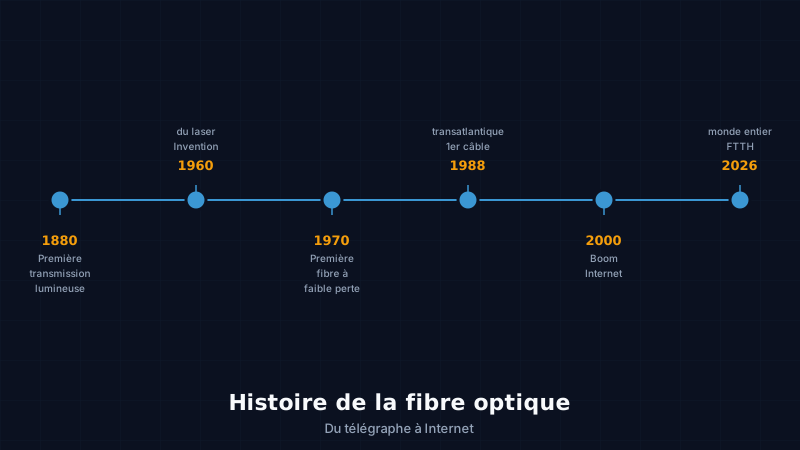
Timeline of major milestones
| Year | Event | Significance |
|---|---|---|
| 1837 | Invention of the telegraph (Morse) | First electrical transmission of information |
| 1858 | First transatlantic copper cable | Europe and America connected |
| 1870 | Tyndall demonstrates total internal reflection | Physical principle of fiber optics |
| 1876 | Bell invents the telephone | Transmission of the human voice |
| 1880 | Bell invents the photophone | First idea of communication via light |
| 1966 | Charles Kao’s article | Practical fiber theoretically demonstrated |
| 1970 | Corning produces the first fiber < 20 dB/km | Practical fiber optics achieved |
| 1977 | First commercial fiber telephone network | Chicago, 44.7 Mbit/s |
| 1988 | Transatlantic cable TAT-8 | First commercial undersea fiber |
| 1990s | Internet explosion | Fiber indispensable to the global network |
| 2002 | SAT-3/WASC cable | Côte d’Ivoire connected to Europe |
| 2009 | Nobel Prize for Charles Kao | Global recognition |
| 2010s | FTTH rollout in Abidjan | Fiber reaching Ivorian homes |
| 2026 | Today | Fiber = backbone of the Internet |
Review quiz
Question 1 — Who invented the telephone in 1876?
- A) Samuel Morse
- B) Alexander Graham Bell ✅
- C) Charles Kao
- D) John Tyndall
Answer: B — Alexander Graham Bell invented the telephone in 1876. He also invented the photophone in 1880.
Question 2 — What physical phenomenon makes fiber optics possible?
- A) Electrical conductivity
- B) Fluorescence
- C) Total internal reflection ✅
- D) Diffraction
Answer: C — Total internal reflection, demonstrated by John Tyndall in 1870, allows light to “slide” inside a glass fiber without escaping.
Question 3 — What was Charles Kao’s major discovery in 1966?
- A) He invented the laser
- B) He proved that fiber losses could drop below 20 dB/km by purifying the glass ✅
- C) He laid the first transatlantic cable
- D) He invented the Internet protocol
Answer: B — Kao demonstrated that the excessive losses in fibers of the era were due to glass impurities, not a fundamental physical limit.
Question 4 — Which undersea cable connected Côte d’Ivoire to Europe in 2002?
- A) TAT-8
- B) WACS
- C) SAT-3/WASC ✅
- D) ACE
Answer: C — The SAT-3/WASC cable, commissioned in 2002, was the first major undersea cable to connect West Africa to Europe.
Conclusion
The history of fiber optics is the story of an idea that took 100 years to become practical. From Tyndall playing with water jets and light in 1870, to Kao proving in 1966 that glass could be made pure enough, to Corning achieving the feat in 1970, to the undersea cables that today border the Ivorian coast — every step required decades of research, investment, and relentless work.
What you learn at KMC is the practical mastery of the result of all those decades of innovation. Every fiber strand you splice, every connector you fit, every joint you make is part of this global network that allows 5 billion people to communicate.
Côte d’Ivoire is today one of the best-connected African countries for fiber optics. Technicians trained in Abidjan are among the most sought-after in the sub-region. The story continues — and you are part of it.
Ready to go further? Discover our fiber optics training programs in Abidjan and join the certified technicians building tomorrow’s network in Côte d’Ivoire.
Go further?
These free courses introduce the key concepts. Join a full certified programme at KMC in Abidjan to become a recognised fibre optic technician.
View certified programmesKMC Team
Training centre · Abidjan